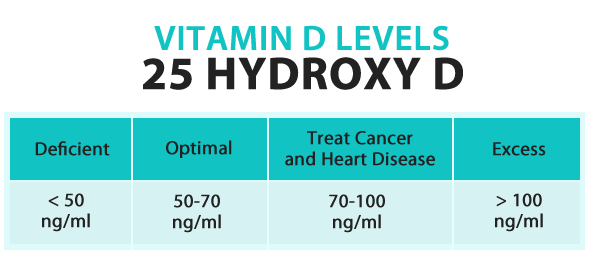
Technically not a "vitamin," vitamin D is in a class by itself. Its metabolic product, calcitriol, is actually a secosteroid hormone that targets over 2000 genes (about 10% of the human genome) in the human body. Current research has implicated vitamin D deficiency as a major factor in the pathology of at least 17 varieties of cancer as well as heart disease, stroke, hypertension, autoimmune diseases, diabetes, depression, chronic pain, osteoarthritis, osteoporosis, muscle weakness, muscle wasting, birth defects, periodontal disease, and more.
Vitamin D's influence on key biological functions vital to one's health and well-being mandates that vitamin D no longer be ignored by the health care industry nor by individuals striving to achieve and maintain a greater state of health.
Saturday, November 21, 2009
Vitamin D Dramatically Cuts Cancer Risk: Study
CTV.ca News Staff
Jun. 7 2007
A landmark new study is raising the tantalizing spectre that a simple and cheap vitamin supplement may offer a highly effective way of preventing cancer.
The research, published in the online edition of the American Journal of Clinical Nutrition, finds that a combination of vitamin D3 and calcium has a substantially marked effect on reducing cancer incidence.
The four-year study out of Creighton University in Nebraska found that women who regularly took vitamin D3 had a 60 percent reduction in cancer infections compared to a group taking placebos.
The study followed 1,179 healthy, women 55 years and older from rural eastern Nebraska between 2000 and 2005. Participants were randomly assigned to receive 1400-1500 mg of calcium alone, or supplemental calcium plus 1,100 IU vitamin D3, or placebo.
Among the 288 women taking placebo, 20 developed breast, colon, lung or another form of cancer. Among the 445 women taking just calcium, 17 developed cancer. But among the largest group -- the 446 women taking vitamin D daily -- just 13 developed cancer.
"What we found is that a vitamin D supplement decreased the cancer incidence in postmenopausal women by about 60 percent," lead investigator Joan Lappe, an associate professor of both medicine and nursing at Creighton University, told CTV News.
Click HERE to read the rest of this article.


Thursday, November 19, 2009
Why Governments Are Selling Vitamin D Short
Reinhold Vieth is frustrated. A thin, bald professor at the University of Toronto's Department of Laboratory Medicine and Patho-biology, Vieth is among the most knowledgeable people in the world on the subject of vitamin D...So why is Dr Vieth so frustrated? You might think he'd have cause for celebration. But for him and other vitamin D researchers around the world, the good news comes with a bitter aftertaste. They believe they can prove vitamin D could help millions live longer and be healthier and yet they have not been able to convince their own governments.
Click HERE to read the rest of this article.
Tuesday, November 17, 2009
MAYO CLINIC PROCEEDINGS: VITAMIN D DEFICIENCY UNIVERSAL AMONG MINORITES WITH CHRONIC PAIN
This month’s Mayo Clinic Proceedings have two important articles about vitamin D deficiency and chronic pain. Both the lead article and the lead editorial discuss the association of vitamin D deficiency and chronic pain. For reasons that are not clear, neither article has yet been posted to PubMed by the National Library of Medicine, nor reported in the media.
Dr. Plotnikoff, of the University of Minnesota Medical School, measured calcidiol [25(OH)D] levels on 150 patients who presented to an outpatient university clinic with nonspecific musculoskeletal pain. They discovered that 100% of the Black, Hispanic, East African and American Indian patients with chronic pain were vitamin D deficient. 93% of all the patients were vitamin D deficient with young women in their childbearing years being at the greatest risk for misdiagnosis or delayed diagnosis. Dr. Plotnikoff (along with co-author, Ms. Quigley) recommended that screening calcidiol [25(OH)D] levels become standard practice is all such clinics. (Plotnikoff, GA and Quigley BA; Prevalence of Severe Hypovitaminosis D in Patients With Persistent, Nonspecific Musculoskeletal Pain; Mayo Clin Proc. 2003:78:1463-1470
Click HERE to read the rest of this article.
Monday, November 16, 2009
Eradicate Breast Cancer With Vitamin D?
Breast cancer risk 'virtually eradicated' by elevated vitamin D levels, researchers suggest.
Reprinted with permission from CNW Group
TORONTO, Nov. 4 /CNW/ - Breast cancer is a disease so directly related to vitamin D deficiency that a woman's risk of contracting the disease can be 'virtually eradicated' by elevating her vitamin D status to what vitamin D scientists consider to be natural blood levels.
That's the message vitamin D pioneer Dr. Cedric Garland delivered in Toronto Tuesday as part of the University of Toronto School of Medicine's "Diagnosis and Treatment of Vitamin D Deficiency" conference - the largest gathering of vitamin D researchers in North America this year. More than 170 researchers, public health officials and health practitioners gathered at the UT Faculty club for the landmark event.
Garland's presentation headlined a conference that reviewed many aspects of the emerging vitamin D research field - a booming discipline that has seen more than 3,000 academic papers this calendar year alone, conference organizers said. That makes vitamin D by far the most prolific topic in medicine this year, with work connecting it with risk reduction in two dozen forms of cancer, heart disease, multiple scleroses and many other disorders.
Click HERE to read the rest of this article.
Saturday, November 14, 2009
H1N1 Swine Flu Deadly in All Age Groups
When Swine Flu Is Bad, It's Really Bad, Data Confirm
By Daniel J. DeNoon
WebMD Health News
Reviewed by Louise Chang, MD
Nov. 3, 2009 - H1N1 swine flu isn't always severe, but when it's bad, it's really bad. Patients hospitalized with pandemic flu have an 11% fatality rate, data from California suggest.
The pandemic flu bug is far more likely to strike younger people. But when people aged 50 and older get hospitalized with H1N1 swine flu, their case-fatality rate is the highest of any group: 18% to 20%.
The findings come from an analysis of data collected from California hospitals during the first 16 weeks of the U.S. H1N1 swine flu pandemic (April 23 to Aug. 11) by Janice K. Louie, MD, MPH, of the California Department of Health and colleagues.
"In contrast with the common perception that pandemic 2009 influenza A (H1N1) causes only mild disease, hospitalization and death occurred at all ages, and up to 30% of hospitalized cases were severely ill," Louie and colleagues report in the current issue of the Journal of the American Medical Association.
In a news conference, CDC Director Thomas Frieden, MD, MPH, said the California data show that H1N1 swine flu is just as deadly as seasonal flu.
"What we have seen in that article and in our own data from around the country and around the world is the level of severity among those who become ill is similar to seasonal flu," Frieden said. "Although a much, much lower proportion of people over 65 get H1N1 compared with seasonal flu, if they get it, it can be every bit as severe."
Click HERE to view the rest of this article.
Wednesday, November 11, 2009
Research Shows Why Diabetics Should Avoid Vitamin D Deficiency
November 9, 2009 by Personal Liberty News Desk
Research shows why diabetics should avoid vitamin D deficiency Based on new research, scientists are beginning to understand why people with diabetes should be particularly wary of vitamin D deficiency.
Anyone with low levels of the vitamin may be at a higher risk for cardiovascular disease, but a team of researchers at Washington University School of Medicine in St. Louis has found vitamin D deficiency causes diabetics to be unable to process cholesterol normally.
As a consequence, cholesterol builds up in their blood vessels, which leads to an elevated risk of heart attack and stroke.
Click HERE to read the rest of this article.
Tuesday, November 10, 2009
Vitamin D and Breast Cancer
MOST COMMON MALIGNANCY FOR WOMEN
Breast cancer is the most common malignancy of women in the western world. Many factors contribute to causing breast malignancy (it is multifactorial), though heredity is a major one. Certain diets help to prevent it, such as diets high in vegetables and fruit and low in fat. Adequate calcium is very important. The role of vitamin D in both the prevention and treatment of breast cancer is being intensively explored by scientists, and the results thus far have been promising.
Click HERE to read the rest of this article.