Technically not a "vitamin," vitamin D is in a class by itself. Its metabolic product, calcitriol, is actually a secosteroid hormone that targets over 2000 genes (about 10% of the human genome) in the human body. Current research has implicated vitamin D deficiency as a major factor in the pathology of at least 17 varieties of cancer as well as heart disease, stroke, hypertension, autoimmune diseases, diabetes, depression, chronic pain, osteoarthritis, osteoporosis, muscle weakness, muscle wasting, birth defects, periodontal disease, and more.
Vitamin D's influence on key biological functions vital to one's health and well-being mandates that vitamin D no longer be ignored by the health care industry nor by individuals striving to achieve and maintain a greater state of health.
Saturday, January 9, 2010
Death rates surge with inadequate vitamin D
Insufficient levels of serum 25-hydroxyvitamin D (25[OH]D) appear to be a major contributor to deaths in older adults, as shown in a study showing vitamin D levels to be inversely proportional to mortality risk in these individuals (J Am Geriatr Soc. 2009;57:1595-1603).
“The association was strong (two times greater odds of mortality for 25[OH]D level <25.0 nmol/L) and appeared linear within the range of the data and independent of common CVD [cardiovascular disease] and mortality risk factors,” researchers note.
The team looked at the vitamin D levels of 3,408 men and women aged 65 years and older upon their enrollment in the Third National Health and Nutrition Examination Survey (NHANES III). After a median 7.3 years of follow-up, 1,493 (44%) of the cohort had died. Slightly more half the deaths (767) were CVD-related.
Compared with participants who had optimal vitamin D status, those who had low vitamin D levels were three times more likely to die from heart disease and 2.5 times more likely to die from any cause. Individuals with baseline 25(OH)D levels <50.0 nmol/L seemed to be at highest risk for mortality, “but levels of 100.0 nmol/L or greater may be necessary for better survival,” researchers observe.”
Saturday, November 21, 2009
Vitamin D Dramatically Cuts Cancer Risk: Study
CTV.ca News Staff
Jun. 7 2007
A landmark new study is raising the tantalizing spectre that a simple and cheap vitamin supplement may offer a highly effective way of preventing cancer.
The research, published in the online edition of the American Journal of Clinical Nutrition, finds that a combination of vitamin D3 and calcium has a substantially marked effect on reducing cancer incidence.
The four-year study out of Creighton University in Nebraska found that women who regularly took vitamin D3 had a 60 percent reduction in cancer infections compared to a group taking placebos.
The study followed 1,179 healthy, women 55 years and older from rural eastern Nebraska between 2000 and 2005. Participants were randomly assigned to receive 1400-1500 mg of calcium alone, or supplemental calcium plus 1,100 IU vitamin D3, or placebo.
Among the 288 women taking placebo, 20 developed breast, colon, lung or another form of cancer. Among the 445 women taking just calcium, 17 developed cancer. But among the largest group -- the 446 women taking vitamin D daily -- just 13 developed cancer.
"What we found is that a vitamin D supplement decreased the cancer incidence in postmenopausal women by about 60 percent," lead investigator Joan Lappe, an associate professor of both medicine and nursing at Creighton University, told CTV News.
Click HERE to read the rest of this article.


Monday, November 16, 2009
Eradicate Breast Cancer With Vitamin D?
Breast cancer risk 'virtually eradicated' by elevated vitamin D levels, researchers suggest.
Reprinted with permission from CNW Group
TORONTO, Nov. 4 /CNW/ - Breast cancer is a disease so directly related to vitamin D deficiency that a woman's risk of contracting the disease can be 'virtually eradicated' by elevating her vitamin D status to what vitamin D scientists consider to be natural blood levels.
That's the message vitamin D pioneer Dr. Cedric Garland delivered in Toronto Tuesday as part of the University of Toronto School of Medicine's "Diagnosis and Treatment of Vitamin D Deficiency" conference - the largest gathering of vitamin D researchers in North America this year. More than 170 researchers, public health officials and health practitioners gathered at the UT Faculty club for the landmark event.
Garland's presentation headlined a conference that reviewed many aspects of the emerging vitamin D research field - a booming discipline that has seen more than 3,000 academic papers this calendar year alone, conference organizers said. That makes vitamin D by far the most prolific topic in medicine this year, with work connecting it with risk reduction in two dozen forms of cancer, heart disease, multiple scleroses and many other disorders.
Click HERE to read the rest of this article.
Wednesday, November 11, 2009
Research Shows Why Diabetics Should Avoid Vitamin D Deficiency
November 9, 2009 by Personal Liberty News Desk
Research shows why diabetics should avoid vitamin D deficiency Based on new research, scientists are beginning to understand why people with diabetes should be particularly wary of vitamin D deficiency.
Anyone with low levels of the vitamin may be at a higher risk for cardiovascular disease, but a team of researchers at Washington University School of Medicine in St. Louis has found vitamin D deficiency causes diabetics to be unable to process cholesterol normally.
As a consequence, cholesterol builds up in their blood vessels, which leads to an elevated risk of heart attack and stroke.
Click HERE to read the rest of this article.
Tuesday, November 10, 2009
Vitamin D and Breast Cancer
MOST COMMON MALIGNANCY FOR WOMEN
Breast cancer is the most common malignancy of women in the western world. Many factors contribute to causing breast malignancy (it is multifactorial), though heredity is a major one. Certain diets help to prevent it, such as diets high in vegetables and fruit and low in fat. Adequate calcium is very important. The role of vitamin D in both the prevention and treatment of breast cancer is being intensively explored by scientists, and the results thus far have been promising.
Click HERE to read the rest of this article.
Friday, November 6, 2009
Doctors start to include vitamin D in fight against cancer
Oncology treatments
With new studies showing the sun vitamin may slow come cancers, some physicians are eager to add it to treatment programs.
Responding to research indicating that vitamin D may slow the progression of breast, colon and other common cancers, some doctors have begun adding the supplement to their tool kit of cancer therapies alongside more conventional treatments such as radiation, surgery and chemotherapy.
Click HERE to read the rest of this article.
Monday, October 19, 2009
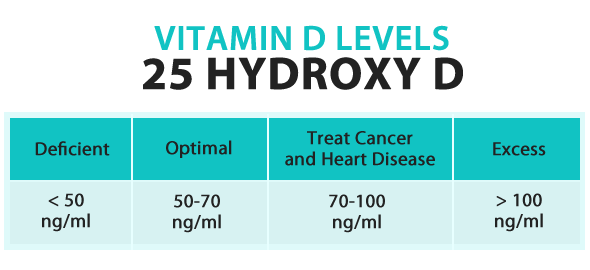
Determine Your OPTIMAL Level of Vitamin D
Click on image to open in new window.
Keeping your level in this range, and even erring toward the higher numbers in this range, is going to give you the most protective benefit। And the way you maintain your levels within this range is by getting tested regularly – say two to four times a year in the beginning, and adjusting your vitamin D intake accordingly.
CHANGE 'Breast Cancer Awareness Month' to 'Breast Cancer PREVENTION Month'
It's time. The tools are at hand. It just takes our combined efforts. Drs Cedric Garland, UCSD School of Medicine and Tracey O'Connor, Roswell Park Cancer Institute will present information on how prevention can work with vitamin D and, what a cancer treatment protocol would look like. Save your daughters!--your wives, your friends, your patients from this disease.
Don't stop with breast cancer--infectious diseases, type 1 diabetes, hypertension, colon cancer, falls in the elderly are just a few more diseases that are affected by vitamin D serum levels. The objective of the seminar will be to provide all health care professionals with the information needed to take action NOW. It is estimated that 25-50% of any healthcare budget could be saved with vitamin D serum levels between 40-60 ng/ml (100-150 nmol/L).
Reduce All Cancer Incidence by 77% with Vitamin D? - Seminar
The Grassroots Health organization has announced a seminar on the health impact of solving the vitamin D deficiency epidemic. The seminar will be held on November 3, 2009 at the University of Toronto, Ontario, Canada. The price is $55, and includes a free vitamin D test for those registering by October 15.
While directed at health professionals, the mere existence of the seminar should underscore the potential health benefits of everyone getting enough vitamin D. Among the statistics cited in the seminar announcement are a 77% reduction in all cancer incidence, a 80% reduction in breast cancer, and a 78% reduction in type-1 diabetes.
Sunday, October 18, 2009
Vitamin D Can Save Your Life
"It is estimated that 25 to 50 percent of any healthcare budget could be saved with adequate vitamin D serum levels."
This is an amazing statement! Read on and listen to the videos in the following links for a low cost supplement that could save your life.
"When it comes to the benefits of optimizing your vitamin D levels, the evidence is simply overwhelming. Research shows you can drastically reduce your risk of cancer and countless other chronic diseases by getting safe sun exposure, using a safe tanning bed, or taking a high-quality supplement.
Yet, a great deal of people around the world have heard nothing of this great “discovery.” It’s even likely that your doctor is among them, which is why it’s so important to educate yourself.
*Recommended Daily Intake for Optimal Health*
Based on the most recent research, the current recommendation is 35 IU’s of vitamin D3 per pound of body weight.
So for a child weighing 40 pounds, the recommended average dose
would be 1,400 IU’s daily, and for a 170-pound adult, the dose would
be nearly 6,000 IU’s.
However, it’s important to realize that vitamin D requirements are
/highly individual/, as your vitamin D status is dependent on
numerous factors, such as the color of your skin, your location, and
how much sunshine you’re exposed to on a regular basis."


