Technically not a "vitamin," vitamin D is in a class by itself. Its metabolic product, calcitriol, is actually a secosteroid hormone that targets over 2000 genes (about 10% of the human genome) in the human body. Current research has implicated vitamin D deficiency as a major factor in the pathology of at least 17 varieties of cancer as well as heart disease, stroke, hypertension, autoimmune diseases, diabetes, depression, chronic pain, osteoarthritis, osteoporosis, muscle weakness, muscle wasting, birth defects, periodontal disease, and more.
Vitamin D's influence on key biological functions vital to one's health and well-being mandates that vitamin D no longer be ignored by the health care industry nor by individuals striving to achieve and maintain a greater state of health.
Wednesday, December 30, 2009
Vitamin D may help in the battle with diabetes
Discussion
By SUZY COHEN - For the Herald & Review | Posted: Tuesday, November 10, 2009 10:00 pm
Dear Suzy: I read your Facebook post about vitamin D and how it works better than diabetic medications. I have diabetes, and no one has ever told me this. Would you share more information?
- L.N. Denver, Colo.
A: Diabetes is an inflammatory condition; it is not just about high blood sugar, as most people think. If left to run its devastating course, diabetes could steal your vision, destroy your kidneys and cause nerve pain, heart attack, stroke or amputation. So we have to take diabetes seriously and do all that we can to reduce blood sugar (glucose) and make our cells happier to see insulin (improve insulin sensitivity).
Doctors have many medications at their disposal to reduce blood glucose. I think natural vitamin D can help, too, so I posted that comment on Facebook and Twitter. I was trying to help people with diabetes because they may not know that it's an inexpensive, over-the-counter dietary supplement.
My comment was based in clinical science - more specifically, on a 2004 study published in the American Journal of Clinical Nutrition that found that raising a person's blood levels of vitamin D (from 25 to 75 nmol/l) could improve insulin sensitivity by a whopping 60 percent. Compare that to metformin, one of our pharmaceutical gold standards, which can dispose of blood sugar by a meager 13 percent according to the New England Journal of Medicine.
Click HERE to read the rest of this article.


Autism Therapy: Vitamin D and Autism
I’ve notice lately that Vitamin D seems to be the “latest” thing people are buzzing about in the autism community. Vitamin D as an autism therapy. Seems reasonable. Children with autism present with muscular weakness, which is a symptom of Vitamin D deficiency. Children with autism also have intestinal absorption issues, which makes it difficult for them to properly digest their food. Making it nearly impossible to get the proper nutrients and vitamins from their food. Vitamin D as autism therapy? Plausible. Let’s explore what the experts are saying.
Click HERE to read the rest of this article.
Monday, November 23, 2009
Reduce breast cancer risk with Vitamin D
Summary of Findings in Breast Cancer.
Breast cancer patients with low levels of vitamin D and followed for up to eleven years had a 70% greater chance of dying and twice the rate of developing metastasis than did patients with high levels of vitamin D
Click HERE to read abstract of this research.
Saturday, November 21, 2009
Vitamin D Dramatically Cuts Cancer Risk: Study
CTV.ca News Staff
Jun. 7 2007
A landmark new study is raising the tantalizing spectre that a simple and cheap vitamin supplement may offer a highly effective way of preventing cancer.
The research, published in the online edition of the American Journal of Clinical Nutrition, finds that a combination of vitamin D3 and calcium has a substantially marked effect on reducing cancer incidence.
The four-year study out of Creighton University in Nebraska found that women who regularly took vitamin D3 had a 60 percent reduction in cancer infections compared to a group taking placebos.
The study followed 1,179 healthy, women 55 years and older from rural eastern Nebraska between 2000 and 2005. Participants were randomly assigned to receive 1400-1500 mg of calcium alone, or supplemental calcium plus 1,100 IU vitamin D3, or placebo.
Among the 288 women taking placebo, 20 developed breast, colon, lung or another form of cancer. Among the 445 women taking just calcium, 17 developed cancer. But among the largest group -- the 446 women taking vitamin D daily -- just 13 developed cancer.
"What we found is that a vitamin D supplement decreased the cancer incidence in postmenopausal women by about 60 percent," lead investigator Joan Lappe, an associate professor of both medicine and nursing at Creighton University, told CTV News.
Click HERE to read the rest of this article.
Thursday, November 19, 2009
Why Governments Are Selling Vitamin D Short
Reinhold Vieth is frustrated. A thin, bald professor at the University of Toronto's Department of Laboratory Medicine and Patho-biology, Vieth is among the most knowledgeable people in the world on the subject of vitamin D...So why is Dr Vieth so frustrated? You might think he'd have cause for celebration. But for him and other vitamin D researchers around the world, the good news comes with a bitter aftertaste. They believe they can prove vitamin D could help millions live longer and be healthier and yet they have not been able to convince their own governments.
Click HERE to read the rest of this article.
Tuesday, November 17, 2009
MAYO CLINIC PROCEEDINGS: VITAMIN D DEFICIENCY UNIVERSAL AMONG MINORITES WITH CHRONIC PAIN
This month’s Mayo Clinic Proceedings have two important articles about vitamin D deficiency and chronic pain. Both the lead article and the lead editorial discuss the association of vitamin D deficiency and chronic pain. For reasons that are not clear, neither article has yet been posted to PubMed by the National Library of Medicine, nor reported in the media.
Dr. Plotnikoff, of the University of Minnesota Medical School, measured calcidiol [25(OH)D] levels on 150 patients who presented to an outpatient university clinic with nonspecific musculoskeletal pain. They discovered that 100% of the Black, Hispanic, East African and American Indian patients with chronic pain were vitamin D deficient. 93% of all the patients were vitamin D deficient with young women in their childbearing years being at the greatest risk for misdiagnosis or delayed diagnosis. Dr. Plotnikoff (along with co-author, Ms. Quigley) recommended that screening calcidiol [25(OH)D] levels become standard practice is all such clinics. (Plotnikoff, GA and Quigley BA; Prevalence of Severe Hypovitaminosis D in Patients With Persistent, Nonspecific Musculoskeletal Pain; Mayo Clin Proc. 2003:78:1463-1470
Click HERE to read the rest of this article.
Monday, October 19, 2009
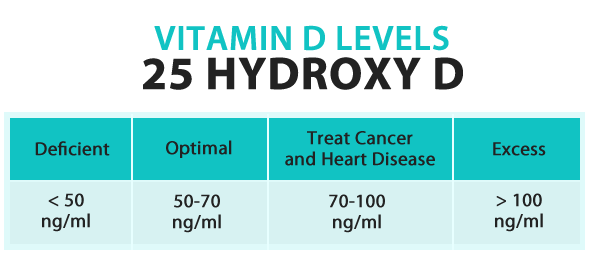
Determine Your OPTIMAL Level of Vitamin D
Click on image to open in new window.
Keeping your level in this range, and even erring toward the higher numbers in this range, is going to give you the most protective benefit। And the way you maintain your levels within this range is by getting tested regularly – say two to four times a year in the beginning, and adjusting your vitamin D intake accordingly.
CHANGE 'Breast Cancer Awareness Month' to 'Breast Cancer PREVENTION Month'
It's time. The tools are at hand. It just takes our combined efforts. Drs Cedric Garland, UCSD School of Medicine and Tracey O'Connor, Roswell Park Cancer Institute will present information on how prevention can work with vitamin D and, what a cancer treatment protocol would look like. Save your daughters!--your wives, your friends, your patients from this disease.
Don't stop with breast cancer--infectious diseases, type 1 diabetes, hypertension, colon cancer, falls in the elderly are just a few more diseases that are affected by vitamin D serum levels. The objective of the seminar will be to provide all health care professionals with the information needed to take action NOW. It is estimated that 25-50% of any healthcare budget could be saved with vitamin D serum levels between 40-60 ng/ml (100-150 nmol/L).
Reduce All Cancer Incidence by 77% with Vitamin D? - Seminar
The Grassroots Health organization has announced a seminar on the health impact of solving the vitamin D deficiency epidemic. The seminar will be held on November 3, 2009 at the University of Toronto, Ontario, Canada. The price is $55, and includes a free vitamin D test for those registering by October 15.
While directed at health professionals, the mere existence of the seminar should underscore the potential health benefits of everyone getting enough vitamin D. Among the statistics cited in the seminar announcement are a 77% reduction in all cancer incidence, a 80% reduction in breast cancer, and a 78% reduction in type-1 diabetes.


