

Technically not a "vitamin," vitamin D is in a class by itself. Its metabolic product, calcitriol, is actually a secosteroid hormone that targets over 2000 genes (about 10% of the human genome) in the human body. Current research has implicated vitamin D deficiency as a major factor in the pathology of at least 17 varieties of cancer as well as heart disease, stroke, hypertension, autoimmune diseases, diabetes, depression, chronic pain, osteoarthritis, osteoporosis, muscle weakness, muscle wasting, birth defects, periodontal disease, and more.
Vitamin D's influence on key biological functions vital to one's health and well-being mandates that vitamin D no longer be ignored by the health care industry nor by individuals striving to achieve and maintain a greater state of health.
Monday, November 23, 2009
Reduce breast cancer risk with Vitamin D
Summary of Findings in Breast Cancer.
Breast cancer patients with low levels of vitamin D and followed for up to eleven years had a 70% greater chance of dying and twice the rate of developing metastasis than did patients with high levels of vitamin D
Click HERE to read abstract of this research.


Saturday, November 21, 2009
Vitamin D Dramatically Cuts Cancer Risk: Study
CTV.ca News Staff
Jun. 7 2007
A landmark new study is raising the tantalizing spectre that a simple and cheap vitamin supplement may offer a highly effective way of preventing cancer.
The research, published in the online edition of the American Journal of Clinical Nutrition, finds that a combination of vitamin D3 and calcium has a substantially marked effect on reducing cancer incidence.
The four-year study out of Creighton University in Nebraska found that women who regularly took vitamin D3 had a 60 percent reduction in cancer infections compared to a group taking placebos.
The study followed 1,179 healthy, women 55 years and older from rural eastern Nebraska between 2000 and 2005. Participants were randomly assigned to receive 1400-1500 mg of calcium alone, or supplemental calcium plus 1,100 IU vitamin D3, or placebo.
Among the 288 women taking placebo, 20 developed breast, colon, lung or another form of cancer. Among the 445 women taking just calcium, 17 developed cancer. But among the largest group -- the 446 women taking vitamin D daily -- just 13 developed cancer.
"What we found is that a vitamin D supplement decreased the cancer incidence in postmenopausal women by about 60 percent," lead investigator Joan Lappe, an associate professor of both medicine and nursing at Creighton University, told CTV News.
Click HERE to read the rest of this article.
Monday, November 16, 2009
Eradicate Breast Cancer With Vitamin D?
Breast cancer risk 'virtually eradicated' by elevated vitamin D levels, researchers suggest.
Reprinted with permission from CNW Group
TORONTO, Nov. 4 /CNW/ - Breast cancer is a disease so directly related to vitamin D deficiency that a woman's risk of contracting the disease can be 'virtually eradicated' by elevating her vitamin D status to what vitamin D scientists consider to be natural blood levels.
That's the message vitamin D pioneer Dr. Cedric Garland delivered in Toronto Tuesday as part of the University of Toronto School of Medicine's "Diagnosis and Treatment of Vitamin D Deficiency" conference - the largest gathering of vitamin D researchers in North America this year. More than 170 researchers, public health officials and health practitioners gathered at the UT Faculty club for the landmark event.
Garland's presentation headlined a conference that reviewed many aspects of the emerging vitamin D research field - a booming discipline that has seen more than 3,000 academic papers this calendar year alone, conference organizers said. That makes vitamin D by far the most prolific topic in medicine this year, with work connecting it with risk reduction in two dozen forms of cancer, heart disease, multiple scleroses and many other disorders.
Click HERE to read the rest of this article.
Optimal blood levels for vitamin d
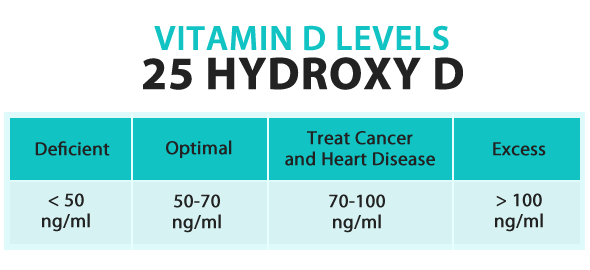
Click on image to enlarge
Reduction of Type 1 Diabetes

Click on graph to enlarge
JOIN the VITAMIN D*ACTION project and get your vitamin d levels tested

Proportion of cancers preventable

Click on chart to enlarge
Disease Prevention by Blood Serium Levels

Click on graft to enlarge.
Blood Spot Test Results

Click on graft to enlarge